How to connect a home battery to solar panels is becoming a practical question for homeowners in 2026. Rising electricity prices, short outages, and smarter energy controls are changing residential power systems. Yet a battery is not simply another appliance beside the inverter. It must match the solar array, inverter, electrical panel, and household loads.
A safe installation usually begins with an energy audit. Review your daily consumption, evening demand, and essential circuits. A refrigerator, router, medical device, or sump pump may need priority during an outage. Battery capacity matters, but power output matters too. A small battery can store plenty of energy and still struggle with a high starting load.
Compatibility comes next. Some systems use an AC-coupled battery, while others connect through a hybrid DC inverter. The choice affects efficiency, wiring, backup performance, and future expansion. Always compare the battery’s voltage range, communication requirements, warranty terms, and temperature limits with the solar equipment. Manufacturer instructions are essential.
Details matter.
A qualified electrician should verify grounding, disconnects, overcurrent protection, and local permit requirements. Utility approval may also be necessary before exporting stored energy to the grid. These steps can feel slow, but skipping them creates expensive risks. Even experienced installers can overlook a panel’s limited capacity or an unsuitable backup circuit. Careful testing, clear labeling, and app-based monitoring help reveal problems early. This guide explains the connection process, common equipment layouts, safety checks, and practical decisions that make a home battery system reliable rather than merely impressive.
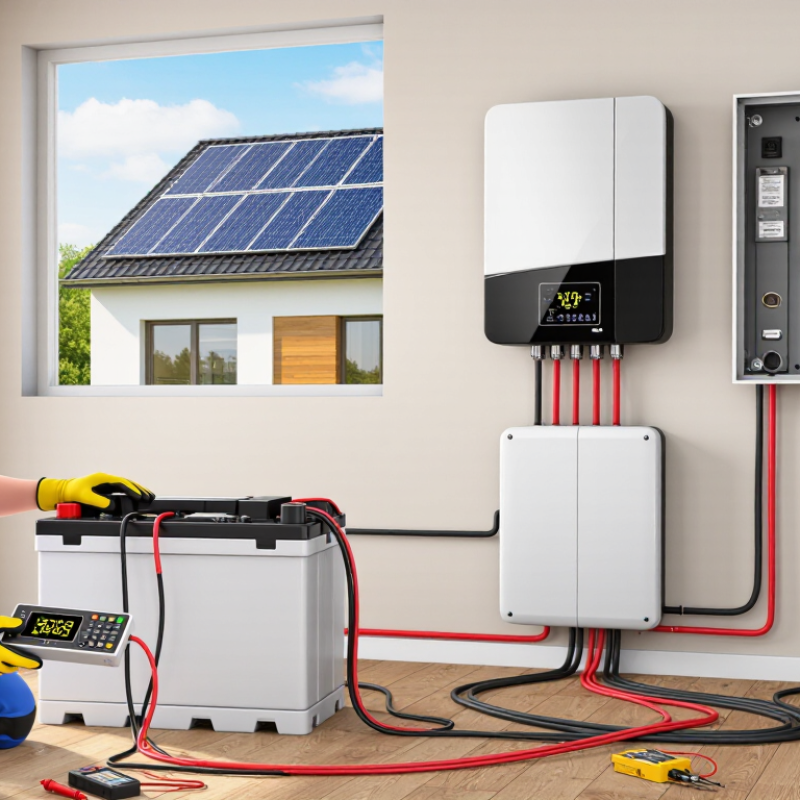
How to Connect a Home Battery to Solar Panels in 2026?
Solar panels produce direct current, while most homes use alternating current. A solar inverter converts that energy for household appliances. A battery system adds another inverter, or uses a hybrid inverter that manages both functions. This choice affects efficiency, installation cost, and backup performance.
A DC-coupled system sends solar power to the battery before inversion. It can reduce conversion losses during charging. An AC-coupled system connects through separate inverters and often suits existing solar installations. The right option depends on panel voltage, inverter limits, battery chemistry, and local electrical rules. A qualified electrician should verify grounding, disconnects, cable sizing, and fire clearances.
Sizing should begin with essential loads, not the entire house. Measure evening consumption, refrigerator startup demand, heating equipment, and expected outage hours. The International Energy Agency’s Renewables 2024 report says global energy storage capacity must increase sixfold by 2030. That growth reflects a practical need: solar production rarely matches household demand. Still, bigger is not always better. Oversizing can leave expensive capacity unused.
Real homes are messier than diagrams. Shading changes, batteries age, and winter output falls. NREL’s Cambium data shows that solar generation varies by location and hour, making local modeling valuable. I would leave expansion space, but not assume perfect future savings. A monitoring system can reveal whether the battery charges fully, discharges overnight, or quietly waits. That evidence should guide later adjustments.
| System Element | Primary Function | Typical Residential Data | How It Connects | Important Considerations |
|---|---|---|---|---|
| Solar Panels | Convert sunlight into direct-current electricity. | Common home systems range from approximately 3 kW to 15 kW of solar capacity. | Panels are wired in series and/or parallel, then connected to a solar inverter or charge-control equipment. | Array voltage and current must remain within the electrical limits of the connected inverter or charge controller. |
| Solar Inverter | Converts solar-panel DC electricity into AC electricity for household loads and the utility grid. | Residential inverter output commonly ranges from approximately 3 kW to 15 kW AC. | Connected between the solar array, the home distribution board, and, where applicable, the battery system. | Battery compatibility, maximum DC voltage, operating current, backup capability, and grid-interconnection requirements must be checked. |
| Battery Inverter or Hybrid Inverter | Controls energy flow between solar panels, the battery, household loads, and the grid. | Often rated for approximately 3 kW to 12 kW of continuous AC power in residential applications. | Solar panels and the battery connect to the inverter on their designated DC or AC terminals; the AC side connects to the home electrical system. | A hybrid inverter can manage solar charging and battery discharging in one unit, while an AC-coupled battery inverter operates alongside an existing solar inverter. |
| Home Battery | Stores surplus solar energy for use at night, during low solar production, or during an outage if backup is supported. | Typical usable storage is approximately 5 kWh to 30 kWh per residential installation. | Connected either directly to a compatible hybrid inverter through a controlled DC connection or to a separate battery inverter through an AC connection. | Usable capacity is lower than nominal capacity because batteries generally reserve energy to protect long-term performance. |
| Battery Management System | Monitors cell voltage, temperature, state of charge, and charging or discharging limits. | Required for modern rechargeable battery packs, including lithium-based residential systems. | Communicates with the battery inverter or hybrid inverter through a dedicated wired communication connection. | Only batteries and inverters with compatible communication protocols and approved operating ranges should be paired. |
| Charge Controller | Regulates the DC power delivered from solar panels to a battery. | Common in off-grid and some DC-coupled systems; maximum input voltage and current depend on the model and array design. | Installed between the solar array and the battery, with protective devices on the appropriate DC circuits. | Many grid-connected hybrid inverters include an integrated charge controller, so a separate unit may not be required. |
| Main Service Panel | Distributes AC electricity to household circuits and connects the home to the utility supply. | Residential service is commonly sized at 100 A, 150 A, or 200 A, depending on local design and electrical demand. | The inverter output is connected through a dedicated breaker or approved connection method. | Panel capacity, busbar limits, breaker positions, and local electrical rules must be evaluated before installation. |
| Backup Loads Panel | Supplies selected essential circuits when the grid is unavailable. | May serve refrigeration, lighting, communications, heating controls, pumps, or selected outlets. | Connected to the backup output of the inverter through a transfer device or integrated backup gateway. | Large loads such as electric resistance heating, whole-home air conditioning, and electric vehicle charging may exceed battery or inverter power limits. |
| Automatic Transfer or Backup Switch | Separates the home from the utility grid during an outage and transfers selected loads to the backup source. | Must be rated for the system voltage, current, fault level, and required transfer function. | Installed between the utility supply, inverter backup output, and the designated backup-load circuits. | Grid isolation is essential to prevent energizing utility lines during an outage and must comply with local safety requirements. |
| DC Disconnect | Provides a means to isolate solar or battery DC circuits for service and emergency procedures. | Voltage and current ratings must be equal to or greater than the connected DC circuit requirements. | Installed in the DC wiring between the panels, battery, and inverter as required by the system design. | DC switching equipment must be specifically rated for DC use; ordinary AC switches are not automatically suitable. |
| AC Disconnect and Circuit Protection | Protects AC wiring from overloads and provides a safe isolation point. | Breaker and disconnect ratings are selected according to inverter output, conductor size, and local code. | Installed between the inverter and the main or backup distribution equipment. | Protection must be coordinated with the inverter's maximum continuous output and the ampacity of the conductors. |
| Energy Meter or Current Sensors | Measures household consumption, solar generation, imports, and exports. | Measurement accuracy and sensor placement depend on the monitoring equipment and system architecture. | Current sensors are placed around selected conductors and connected to the inverter or energy-management controller. | Correct sensor orientation and phase placement are necessary for accurate charging, export, and load-control decisions. |
| Grounding and Bonding | Provides fault-current paths and reduces electrical shock risk. | Requirements vary by system voltage, equipment type, installation method, and jurisdiction. | Metal equipment, enclosures, mounting structures, and required conductors are bonded according to applicable electrical rules. | Grounding and bonding are safety-critical and must be verified by a qualified electrical professional. |
| Monitoring Platform | Displays production, battery state of charge, consumption, grid exchange, and system alerts. | Data may be reported in watts, kilowatts, kilowatt-hours, percentage state of charge, and operating status. | Usually communicates with the inverter through a wired or wireless network connection. | Monitoring data supports troubleshooting but does not replace physical inspection or electrical testing. |
| Solar-to-Battery Energy Flow | Stores excess daytime solar generation for later use. | Charging power is limited by the solar array, inverter, battery charge rate, and available battery capacity. | Solar panels → inverter or charge controller → battery. | When household demand is higher than solar production, the system may direct solar energy to loads first and send only the surplus to the battery. |
| Battery-to-Home Energy Flow | Supplies stored electricity when solar generation is insufficient. | Available output is limited by the battery's continuous power rating, inverter rating, state of charge, and temperature. | Battery → battery or hybrid inverter → home loads. | Starting currents from motors and compressors can be higher than their normal running power and should be considered during system sizing. |
| Grid-Connected Operating Mode | Allows the home to use solar power, charge the battery, import electricity, or export surplus electricity. | Operating rules depend on utility interconnection requirements and applicable electricity tariffs. | Solar and battery equipment remain connected to the utility through approved protection and metering equipment. | Export limits, anti-islanding protection, inspection, and permission to operate may be required. |
| Backup Operating Mode | Keeps selected home circuits powered after the utility supply fails. | Backup duration depends on usable battery capacity, load demand, weather, and solar recharge availability. | Automatic transfer equipment isolates the grid and connects the inverter to the backup-load circuits. | Backup capability is not automatic for every solar-plus-battery system; it must be specifically designed and configured. |
| Battery Sizing Example | Matches storage capacity to expected energy use and backup objectives. | A household using 20 kWh per day might begin evaluating approximately 10–20 kWh of usable storage, depending on the desired backup period and load profile. | Battery capacity is selected together with inverter power, solar capacity, and essential-load requirements. | This is an example range, not a universal recommendation; actual sizing requires measured consumption data and seasonal analysis. |
| Installation and Commissioning | Ensures the system is correctly wired, configured, tested, and approved for operation. | Typically includes electrical inspection, protection testing, inverter configuration, battery communication checks, and backup testing. | All components are verified as one coordinated system before normal operation begins. | Solar panels, batteries, inverters, and distribution equipment should be installed and commissioned by qualified professionals in accordance with local regulations. |
Solar panels produce direct current. Most household appliances use alternating current. The inverter converts the power.
A DC-coupled system sends solar power to the battery before inversion. It may reduce charging losses.
Check panel voltage, inverter limits, battery chemistry, and communication requirements. Installation cost also matters.
Start with essential loads, not the whole house. Include the refrigerator, lights, internet equipment, pumps, and heating devices.
Motors and compressors can briefly demand much more power. A refrigerator may start with a sharp surge.
An electrician should verify breaker ratings, conductor size, grounding, disconnects, panel space, and backup-load separation.
Leave clear space around the battery. Protect it from flooding and excessive heat.
Test solar charging, outage transfer, shutdown controls, and monitoring after installation. Record the readings.
Check whether the battery charges fully, discharges overnight, or remains idle. Compare those patterns with household demand.
Learning how to connect a home battery to solar panels starts with understanding how the solar array, inverter, battery, and household loads work together. First, check system compatibility, including voltage ranges, power ratings, battery chemistry, usable capacity, and backup-load requirements. Confirm that the electrical service, wiring, disconnects, grounding, and protection devices can support the planned installation. The battery should be sized according to energy usage, solar production, and the desired backup duration rather than simply choosing the largest available unit.
Next, select the correct connection method, such as a compatible hybrid inverter or an approved AC-coupled arrangement, based on the existing solar system. Install required isolation, overcurrent protection, monitoring equipment, and other safety controls according to applicable electrical rules. After installation, configure charging, backup priorities, and export settings, then test normal operation, power-loss response, and communications. Regular monitoring can reveal unusual performance, while qualified electrical professionals should handle final connections, inspections, and commissioning.

 Sliver Battery